The MSK Referral Crisis: Why Physical Therapists Can't Afford to Wait for Referrals
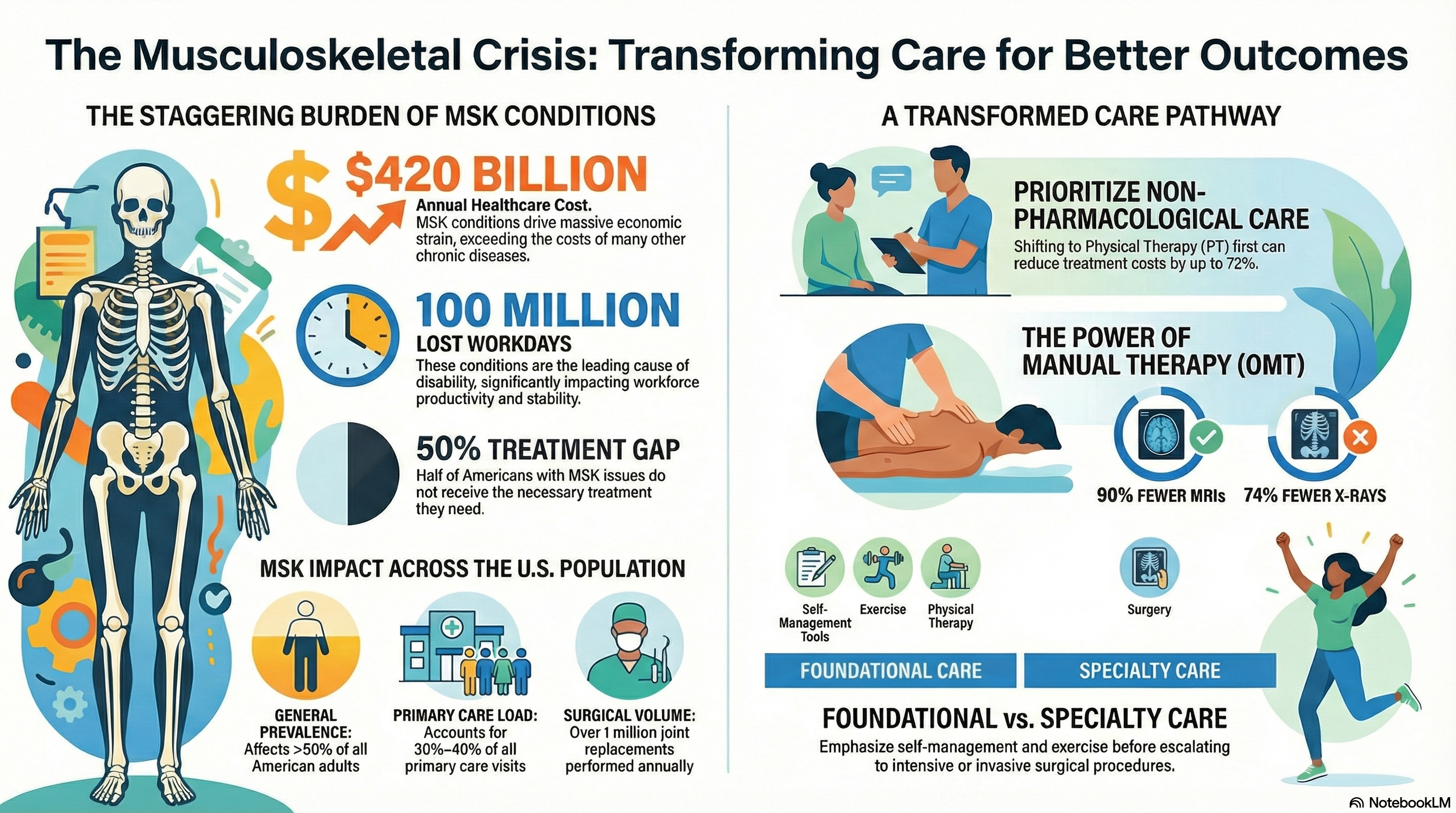
The Staggering Burden of Musculoskeletal Conditions
Musculoskeletal (MSK) conditions represent one of the most significant — and most overlooked — healthcare challenges in the United States. The numbers tell a story that every physical therapist, orthopedic specialist, and primary care physician should understand.
$420 billion in annual healthcare costs. MSK conditions drive massive economic strain, exceeding the costs of many other chronic diseases. This isn't a niche problem — it's a systemic crisis that touches every corner of the healthcare system.
100 million lost workdays. These conditions are the leading cause of disability in the U.S., significantly impacting workforce productivity and stability. When patients can't get timely, effective treatment, the ripple effects extend far beyond the clinic.
A 50% treatment gap. Perhaps the most alarming statistic: half of Americans with MSK issues do not receive the necessary treatment they need. That's not a small gap — it's a chasm, and it represents both a clinical failure and an enormous opportunity for the providers positioned to close it.
MSK Impact Across the U.S. Population
The scope of this crisis becomes even clearer when you look at population-level data:
General prevalence — MSK conditions affect more than 50% of all American adults. This isn't a condition that affects a small subset of patients. It's the majority.
Primary care load — MSK complaints account for 30–40% of all primary care visits. Primary care physicians are overwhelmed with musculoskeletal presentations, many of which they aren't specifically trained to manage optimally.
Surgical volume — Over 1 million joint replacements are performed annually in the U.S. While surgery is sometimes necessary, many of these cases could have been prevented or delayed with earlier, more appropriate intervention.
A Transformed Care Pathway
The data points to a clear conclusion: the current care pathway for MSK conditions is broken. Too many patients go straight from a primary care visit to imaging, opioids, or surgical referrals — skipping the foundational care that could resolve their issues faster, cheaper, and with better outcomes.
Prioritize Non-Pharmacological Care
Research consistently shows that shifting to physical therapy first can reduce treatment costs by up to 72%. That's not a marginal improvement — it's a transformation. When patients receive skilled physical therapy before escalating to more invasive interventions, outcomes improve across the board.
The Power of Manual Therapy (OMT)
Manual therapy and skilled physical therapy intervention have been shown to produce remarkable results. Studies demonstrate 90% fewer MRIs and 74% fewer X-rays when patients receive appropriate physical therapy first. This reduces costs, avoids unnecessary radiation exposure, and gets patients to recovery faster.
Foundational vs. Specialty Care
The evidence supports a clear hierarchy: self-management tools, exercise, and physical therapy should serve as foundational care, with surgery and intensive interventions reserved for cases that don't respond to conservative treatment. This isn't about replacing specialty care — it's about ensuring patients receive the right care at the right time.
What This Means for Physical Therapists
If you're a physical therapist, this data isn't just interesting — it's a call to action. The patients are out there. The need is massive. The outcomes data is on your side. But none of that matters if primary care physicians don't think of you first.
The referral relationship is everything. When a PCP sees a patient with low back pain, knee pain, or shoulder dysfunction, the question is simple: who do they refer to? If your practice isn't top-of-mind, you're losing patients to the surgical pipeline, to pain management clinics, or to no referral at all.
This is why proactive referral relationship management isn't optional — it's the foundation of a thriving PT practice. You can't wait for referrals to come to you. You need a system to cultivate, track, and nurture the relationships that drive your referral pipeline.
Building a Proactive Referral Strategy
The most successful physical therapy practices don't leave referral relationships to chance. They treat them as a core business function with the same rigor they apply to clinical care.
This means knowing every referring provider in your area, tracking every interaction your team has with them, and ensuring no relationship goes cold. It means following up after every referral, sharing outcomes data with referring physicians, and staying visible in the primary care community.
Tools like SixerHQ™ are purpose-built for exactly this challenge — giving PT practices and other healthcare specialists a system to manage referral relationships with the same attention they give to patient care.
The MSK crisis isn't going away. But the physical therapists who build strong, systematic referral relationships will be the ones who close the treatment gap — and build thriving practices in the process.
Ready to build your referral network?
SixerHQ™ helps healthcare specialists track, nurture, and grow the referral relationships that drive their practice.
Start Your Free Trial